Quick answer
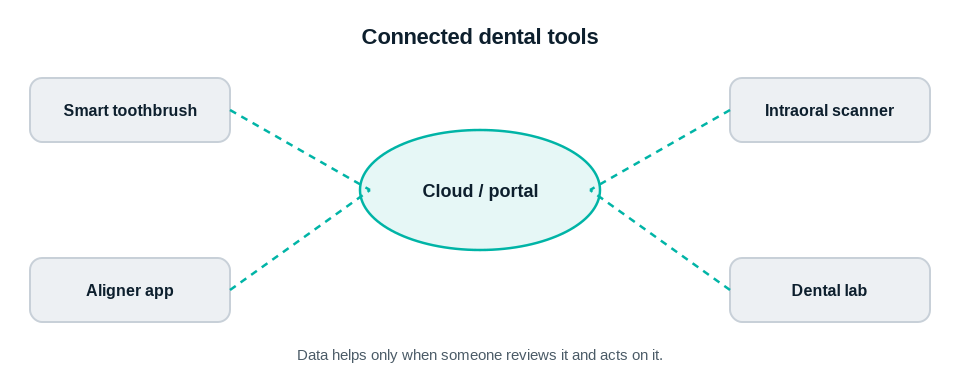
Connected dental tools send data from the mouth to a phone, a clinic system or a lab: smart toothbrushes track brushing, intraoral scanners send cases to the lab in seconds, apps let orthodontists monitor aligners remotely, and wearable sensors record clenching. They help most when the data reaches someone who acts on it.
What makes a device "smart"?
A smart dental device has sensors that collect data, connectivity (Bluetooth, Wi-Fi or the cloud) that sends it somewhere, and software that turns it into something useful: a brushing score, a 3D model, an alert.
Connected tools for patients
| Device | What it does |
|---|---|
| Smart toothbrush | Tracks brushing time, pressure and which areas were missed, via a phone app |
| Smart water flosser | Logs use and reminds patients |
| Aligner monitoring apps | Patients take scan-style photos at home; the orthodontist checks progress remotely |
| Bruxism sensors | Wearable or splint-based sensors record clenching and grinding at night |
What the evidence says: studies suggest app feedback can improve brushing habits, especially in the short term and in orthodontic patients, but long-term evidence on gum health and caries is still limited. These devices support good habits; they do not replace professional care.
Connected tools in the clinic
- Intraoral scanners capture a 3D impression and send it to the lab over the cloud, with no impression material, disinfection or courier.
- Intraoral cameras show patients what the dentist sees.
- Digital X-ray and CBCT feed images into planning software and AI tools. See AI in dentistry.
- Connected autoclaves and equipment log sterilisation cycles and maintenance.
The connected clinic-to-lab workflow
- Scan the preparation in the chair.
- Upload the STL to the lab's portal.
- The lab designs, mills and sinters (see is CAD/CAM accurate?).
- Track the case status online.
- The crown arrives, often the next day.
At Calvora, dentists upload scans in the portal from anywhere in India, track each case and message the lab on WhatsApp. Zirconia crowns that reach us by 7pm are ready the next day.
Things to watch
- Privacy: patient scans and photos are health data. Check where the data is stored and who can access it; India's Digital Personal Data Protection Act, 2023 applies.
- Interoperability: open formats such as STL keep you free to choose your lab and software.
- Real benefit: choose tools whose data someone will actually review and act on.
Frequently asked questions
- What are smart dental devices?
- Dental tools with sensors and connectivity, such as smart toothbrushes, intraoral scanners, aligner monitoring apps and bruxism sensors, that share data with an app, a clinic or a lab.
- Do smart toothbrushes work better?
- They can improve brushing habits through feedback, but long-term evidence on gum health and caries is still limited.
- Can I send intraoral scans to Calvora?
- Yes. Calvora accepts STL files from any intraoral scanner, uploaded through the portal from anywhere in India.