Quick answer
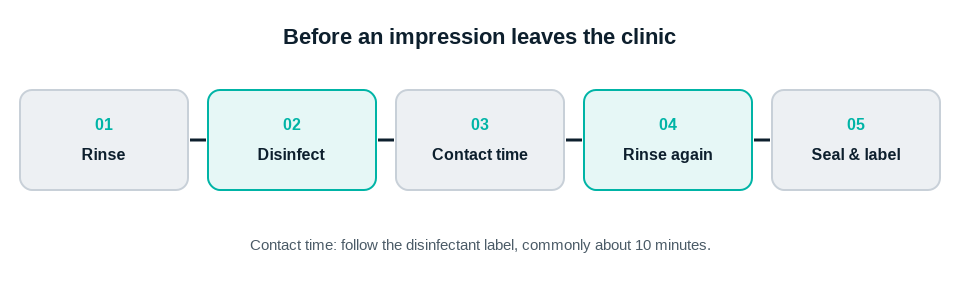
Rinse the impression under running water, disinfect it with a hospital-level disinfectant that is compatible with the material (spray or immerse for the manufacturer's contact time, commonly about 10 minutes), rinse again, then seal it in a labelled bag marked "disinfected". Never send an impression to the lab straight from the mouth.
Why it matters
An impression leaves the mouth carrying saliva, blood and microorganisms. It is then handled by the clinic team, the courier or pickup staff and the lab technician. Disinfection at the clinic protects all of them and is a standard part of infection control.
The challenge is to kill microorganisms without distorting the impression. Some materials absorb water (alginate, polyether) and can swell if immersed too long.
Step by step
- Rinse under gently running water to remove saliva and blood. Disinfectants do not work well through organic debris.
- Shake off excess water.
- Disinfect by spraying or immersion with a disinfectant compatible with the material.
- Wait for the contact time on the disinfectant's label, commonly about 10 minutes. For spraying, keep the impression in a sealed bag so it stays wet.
- Rinse again to remove disinfectant, which can affect the stone surface.
- Seal in a clean zip bag with the prescription in a separate pocket, and label it "disinfected".
Material-by-material guide
| Material | Method | Notes |
|---|---|---|
| Alginate | Spray, or short immersion | Absorbs water: avoid long soaks. Pour or send quickly; alginate distorts as it dries or absorbs water. |
| Addition silicone (PVS) | Immersion | Very stable; tolerates immersion well. |
| Condensation silicone | Immersion | Stable; follow the manufacturer's time. |
| Polyether | Spray, or short immersion | Hydrophilic: limit immersion time to avoid swelling. |
| Bite registrations | Spray or immersion by material | Disinfect like the impression material they are made of. |
| Trays and prostheses for try-in | Immersion or spray | Disinfect both before sending and when they come back. |
Common disinfectant types include sodium hypochlorite solutions (household bleach diluted about 1:10 gives roughly 0.5%), iodophors and commercial impression disinfectants. Always check that the product is approved for impressions and follow its instructions; the impression material manufacturer's guidance comes first.
Common mistakes
- Spraying a dirty impression without rinsing first
- Leaving alginate soaking in disinfectant
- Forgetting the bite registration
- Putting the prescription in the same compartment as the wet impression
- Not labelling the bag, so the lab cannot tell whether it was disinfected
Or skip the impression: send a scan
An intraoral scan removes the disinfection, transport and pouring steps, and the file reaches the lab in seconds. Calvora accepts STL uploads from any scanner, from anywhere in India. For physical impressions, clinics in Pune and PCMC can book a pickup slot; please send them disinfected, sealed and labelled.
Frequently asked questions
- How long should you disinfect an impression?
- For the contact time on the disinfectant's label, commonly about 10 minutes, while keeping hydrophilic materials such as alginate and polyether out of long soaks.
- Can alginate impressions be immersed in disinfectant?
- Only briefly. Alginate absorbs water and distorts, so spraying and sealing in a bag, or a short immersion, is preferred.
- Do digital scans need disinfection?
- No, the file needs none. The scanner tip and wand need cleaning and sterilisation as per the scanner manufacturer.