Quick answer
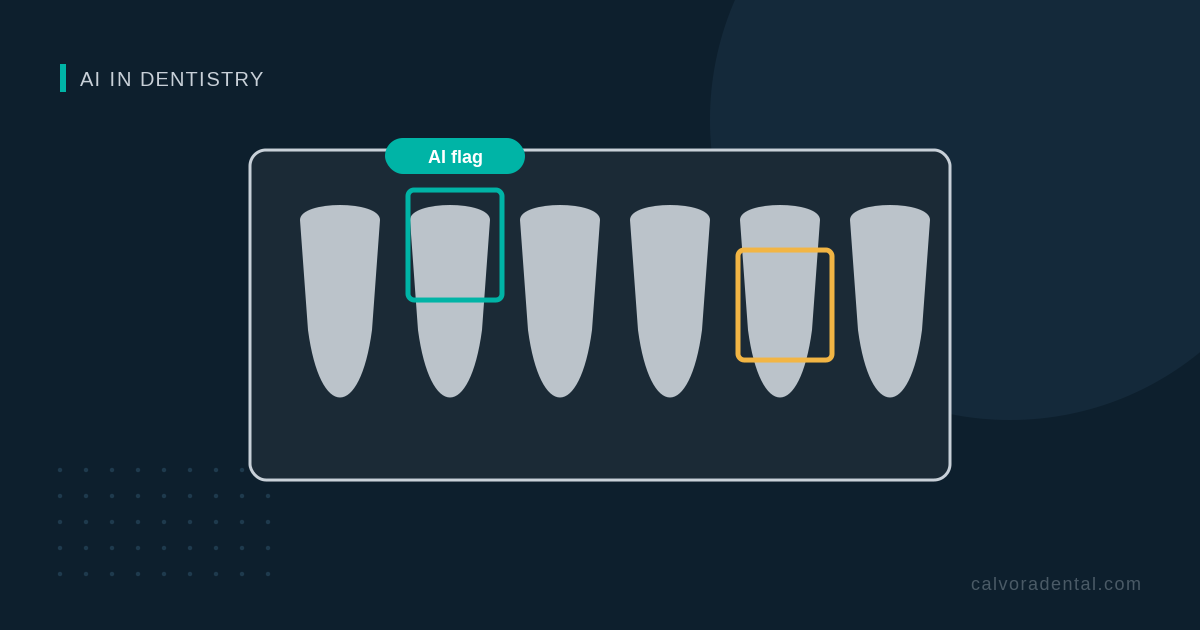
AI is already in everyday dentistry: software flags possible caries and bone loss on X-rays, segments CBCT scans, proposes crown designs and helps plan aligner movements. It speeds up work and adds a second pair of eyes, but the dentist and the technician still make and own every decision.
What "AI" means in dentistry
Most dental AI is machine learning: software trained on thousands of labelled images or designs learns to recognise patterns, such as what early caries looks like on a bitewing, or what a well-shaped molar crown looks like. It does not "understand" dentistry; it predicts based on what it has seen.
Where AI is used today
| Area | What AI does |
|---|---|
| Radiographs | Highlights possible caries, periapical lesions, calculus and bone levels |
| CBCT | Segments teeth, nerve canals and airway for implant and surgical planning |
| Intraoral scans | Cleans up scans and helps detect margin lines |
| Crown design | Proposes a first crown shape that the technician then refines |
| Orthodontics | Segments teeth and suggests staged aligner movements |
| Clinic admin | Appointment reminders, insurance paperwork, note-taking |
Several AI tools for reading dental radiographs have received regulatory clearance in the United States and Europe, and adoption in India is growing with digital X-ray and CBCT use.
Benefits
- Consistency: a tireless second opinion that does not miss a radiograph corner at the end of a long day.
- Speed: CBCT segmentation and first-draft crown designs in minutes.
- Patient communication: highlighted images help patients understand a diagnosis.
- Fewer remakes: better margin detection and design proposals reduce errors downstream.
Limits and cautions
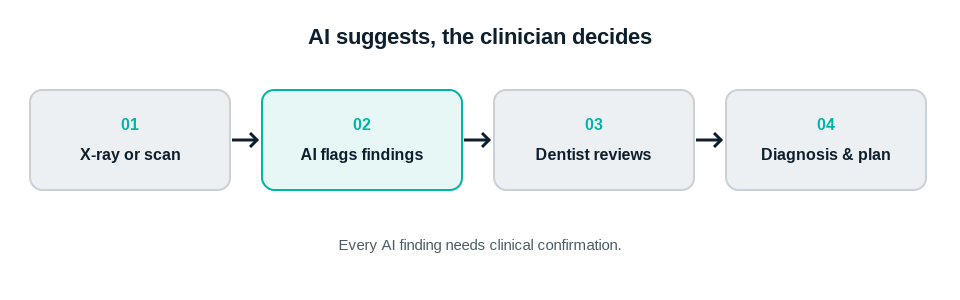
- False positives and negatives. AI can over-call or miss lesions. Every finding needs clinical confirmation.
- Training data. A tool trained on one population or one X-ray sensor may perform differently on another.
- Responsibility. Diagnosis and treatment stay with the dentist.
- Privacy. Patient images are health data. In India, the Digital Personal Data Protection Act, 2023 applies; check where a tool stores and processes your data.
What it means for dental labs
In the lab, AI mainly speeds up design: it can propose anatomy, contacts and occlusion as a starting point. The quality still depends on the technician who checks the margin, adjusts the occlusion against the bite and approves the design before milling. At Calvora every design is checked by a technician in exocad before it goes to the mill. See what is done in a dental lab.
Getting started in your clinic
- Go digital first: digital X-rays and an intraoral scanner.
- Trial an AI radiograph tool on past cases you already know the answers to.
- Keep your own diagnosis first, and use AI as a check.
- Work with a digital lab that accepts STL uploads, so the whole chain stays digital. See smart dental devices.
Frequently asked questions
- How is AI used in dentistry?
- Mainly to analyse X-rays and CBCT scans, propose crown designs, plan aligner treatment and handle clinic admin.
- Will AI replace dentists?
- No. AI supports diagnosis and speeds up design, but examination, treatment decisions and clinical work remain the dentist's job.
- Is AI accurate at finding cavities?
- It can be a useful second opinion, but it produces both false positives and misses, so every finding must be confirmed clinically.