Quick answer
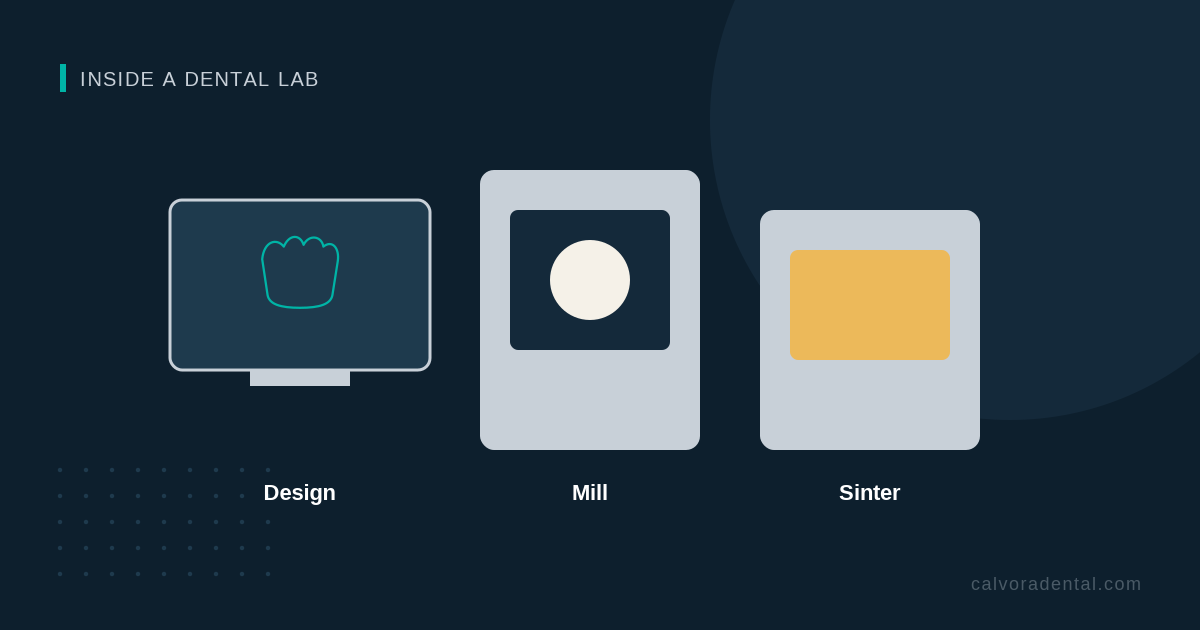
A dental lab makes the crowns, bridges, veneers, implant restorations, dentures and appliances that a dentist prescribes. In a digital lab the case is scanned, designed on a computer, milled or 3D-printed, sintered or fired, stained and glazed, checked and delivered, often within a day or two.
What dental labs make
- Crowns and bridges: zirconia, EMAX, PFM, metal
- Veneers
- Implant crowns, abutments and full-arch frameworks
- Dentures and partial dentures
- Night guards, splints and aligner models
- Temporary crowns and trial smiles
- 3D-printed models and surgical guides
The process, step by step
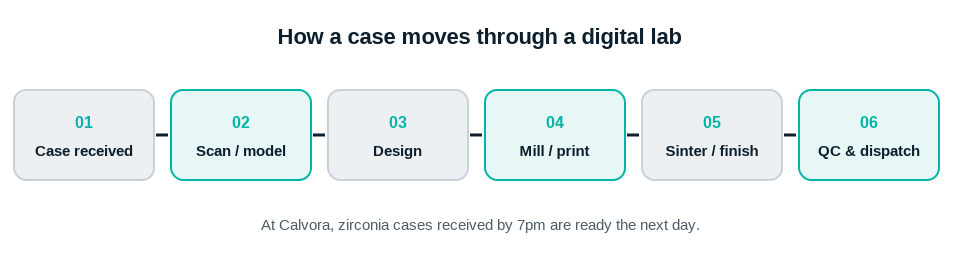
- Case received. A digital scan arrives by upload, or a physical impression is picked up from the clinic with a prescription (tooth, material, shade).
- Scan or model. Impressions are poured in stone or scanned. Digital cases may get a 3D-printed model.
- Design. A technician designs the restoration in software such as exocad: margin, anatomy, contacts and occlusion.
- Manufacture. Zirconia and PMMA are milled from discs; metal frameworks are laser-sintered (DMLS) or milled; models and guides are 3D-printed; EMAX is milled or pressed.
- Sintering or firing. Zirconia is sintered in a furnace, where it shrinks to final size and reaches full strength. EMAX is crystallised. Porcelain is fired in layers.
- Finishing. Staining, glazing, polishing, and porcelain layering for layered crowns.
- Quality check. Fit on the model, margins, contacts, occlusion and shade.
- Dispatch. Delivered to the clinic, with an invoice.
People in a dental lab
| Role | What they do |
|---|---|
| CAD designer | Designs restorations on the computer |
| Milling / CAM technician | Runs the mills, printers and furnaces |
| Ceramist | Stains, glazes and layers porcelain |
| QC technician | Checks every case before dispatch |
| Logistics | Pickup and delivery to clinics |
Analogue vs digital labs
Traditional labs wax up and cast by hand. Digital labs design on screen and mill or print, which gives consistent results and faster turnaround. Most labs today combine both. Read is CAD/CAM accurate?
Inside Calvora
Calvora is a digital lab in Wakad, Pune: exocad design, MEK 5-axis and 4-axis milling, in-house zirconia sintering and 3D printing. Zirconia crowns that reach us by 7pm are ready the next day. See our technology and how it works.
Frequently asked questions
- What is the work of a dental lab?
- To make the crowns, bridges, veneers, implant restorations, dentures and appliances a dentist prescribes, to the dentist's specifications.
- How long does a dental lab take to make a crown?
- Often several days with a traditional workflow. A digital lab with in-house milling and sintering can deliver a zirconia crown the next day; Calvora takes 30 hours from receipt.
- Does a dental lab see patients?
- No. The lab works from the dentist's prescription, scans, impressions and photos.