Quick answer
A good zirconia lab gets three things right: precision (the right grade of zirconia, milled on a well-maintained 5-axis machine and sintered on the correct programme), fit (clear margins, tight contacts, correct cement gap), and finish (natural shade with stain and glaze, and a high polish on contact areas).
Precision: material and machine
| Question | Why it matters |
|---|---|
| Which zirconia brands and grades? | 3Y, 4Y, 5Y and multilayer each suit different cases. See translucent vs high-strength zirconia. |
| 4-axis or 5-axis milling? | 5-axis reaches undercuts and angled screw channels. |
| How are burs tracked? | Worn burs lose detail at margins and fissures. |
| Is sintering in-house? | The correct programme for each brand controls shrinkage, strength and shade. |
Fit: design and margins
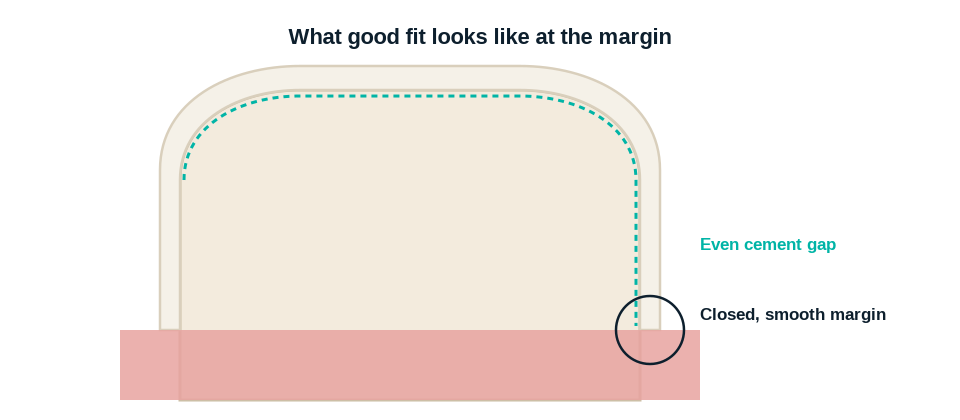
- Margin line placed by the technician on a clear scan, and the lab tells you if it is unclear.
- Cement gap set for the material and your cement.
- Contacts tight enough that floss snaps through.
- Occlusion designed against the opposing scan and bite, with light contacts.
- Emergence profile that supports the gum, not a bulky overcontour.
Finish: what the patient sees
- Internal and external staining matched to the shade and photo
- Glaze for lustre, plus a mechanical polish on occlusal and contact areas (polished zirconia is gentler on the opposing tooth than glaze alone, once the glaze wears)
- Smooth, rounded embrasures and natural surface texture on anteriors
Your first-case checklist
- Seats without adjusting the inside
- Margins closed and smooth under an explorer
- Contacts present and not overly tight
- Occlusion needs minimal adjustment
- Shade matches in daylight
- Delivered on the promised day
How Calvora works
- exocad design, checked by a technician before milling
- MEK T8 Pro 5-axis wet mill with a 32-tool changer, plus an MEK X5 dry mill for zirconia
- In-house sintering overnight, so crowns and bridges up to 5 units are ready in 30 hours
- Monolithic and multilayer zirconia from ₹1,500 (posterior) plus GST
See our technology and price list, or read is CAD/CAM accurate?
Frequently asked questions
- What makes a good zirconia lab?
- The right zirconia grade for each case, well-maintained 5-axis milling, correct in-house sintering, careful digital design and a proper stain, glaze and polish.
- Why do zirconia crowns from some labs need adjustment?
- Usually an unclear margin in the scan, a cement gap set too small, over-tight contacts or occlusion designed without a proper bite record.
- Does Calvora mill zirconia in-house?
- Yes. Calvora designs, mills and sinters zirconia in its own lab in Wakad, Pune.