Quick answer
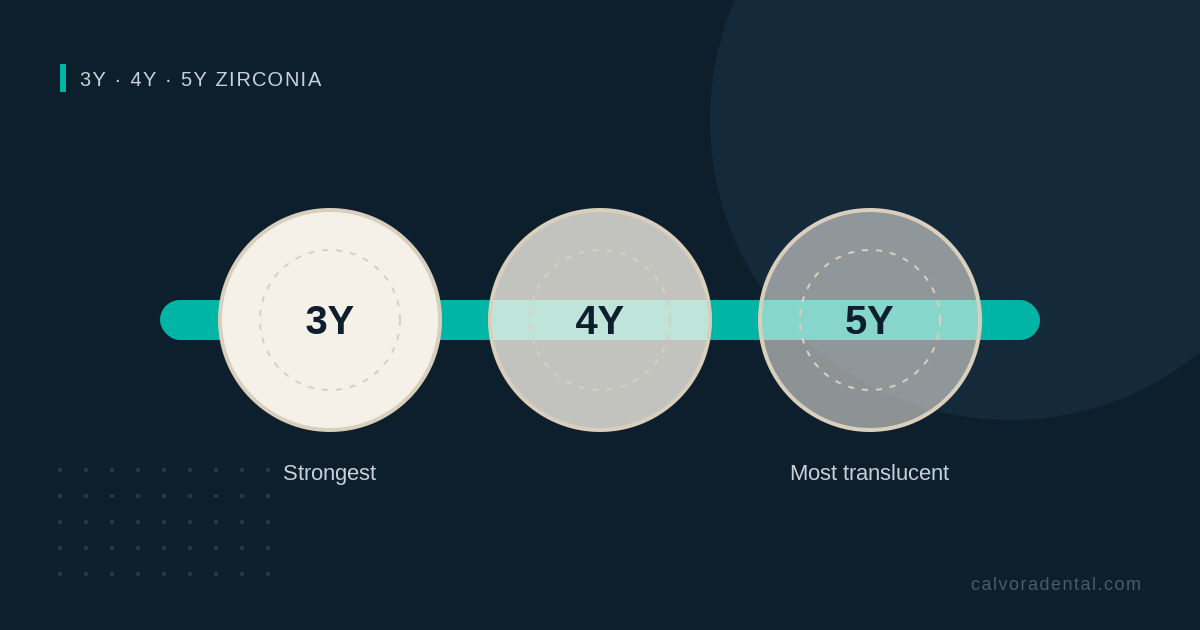
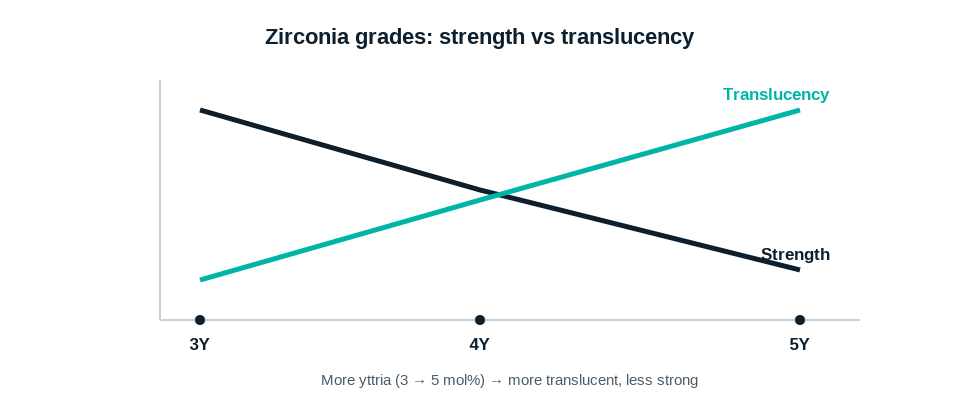
The more yttria a zirconia contains, the more translucent and the weaker it is. 3Y (about 1,000 to 1,200 MPa) is for posterior bridges, frameworks and bruxers. 4Y (about 800 to 1,000 MPa) suits posterior and premolar crowns. 5Y (about 600 to 750 MPa) is for anterior single crowns. Multilayer hybrid discs combine a strong body with a translucent edge.
What 3Y, 4Y and 5Y mean
Dental zirconia is stabilised with yttria (yttrium oxide). The number is the approximate mol% of yttria:
- 3Y-TZP (about 3 mol%): mostly tetragonal crystals. When a crack starts, the crystals change phase and expand, which squeezes the crack shut. This is why 3Y is so tough.
- 4Y (about 4 mol%): a mix of tetragonal and cubic crystals. A middle ground.
- 5Y (about 5 mol%): a high share of cubic crystals. Cubic crystals scatter less light, so the material is more translucent, but they do not transform to stop cracks, so it is weaker.
Comparison
| 3Y (high strength) | 4Y (balanced) | 5Y (high translucency) | |
|---|---|---|---|
| Flexural strength* | about 1,000 to 1,200 MPa | about 800 to 1,000 MPa | about 600 to 750 MPa |
| Translucency | Low | Medium | High |
| Typical uses | Posterior bridges, implant frameworks, bruxers | Posterior and premolar crowns, short bridges | Anterior single crowns, veneers |
| Long-span bridges | Yes | Short spans only | No |
| Minimum occlusal thickness* | about 0.5 to 0.8 mm | about 0.8 to 1.0 mm | about 1.0 to 1.2 mm |
| Relative disc cost | Lowest | Medium | Higher |
*Typical ranges from manufacturer data. Always follow the instructions for the specific brand.
Multilayer "hybrid" discs
Many premium discs now combine grades in one blank: a 3Y or 4Y body for strength at the cervical and connector area, blending into a 5Y incisal layer for translucency. This gives a single crown or bridge both strength where it is loaded and aesthetics where it shows. See monolithic vs layered vs multilayer.
Durability
- 3Y has the longest clinical track record and the best fracture resistance.
- 5Y is durable as a single crown with adequate thickness, but should not be used for long bridges or thin sections under heavy load.
- All zirconia needs correct connector size in bridges (posterior connectors are commonly designed at 9 mm² or more for high-strength zirconia) and good polishing after adjustment.
Choosing the block for each case
| Case | Block |
|---|---|
| Upper central incisor, single | 5Y or multilayer |
| Six anterior crowns | Multilayer (4Y/5Y) |
| Premolar crown | 4Y or multilayer |
| Molar crown, normal bite | 4Y |
| Molar crown, bruxer | 3Y |
| 3-unit posterior bridge | 3Y or hybrid multilayer |
| Implant full-arch | 3Y or hybrid multilayer |
Cost
5Y and multilayer discs cost more than standard 3Y, and anterior work takes more staining time. At Calvora a posterior zirconia crown is ₹1,500 and an anterior crown ₹1,900, plus GST. See zirconia crown price in India.
Frequently asked questions
- What are the types of zirconia used in dentistry?
- Mainly 3Y (high strength), 4Y (balanced) and 5Y (high translucency) zirconia, plus multilayer discs that combine them.
- Is translucent zirconia weaker?
- Yes. 5Y translucent zirconia is roughly half as strong as 3Y high-strength zirconia, so it is used mainly for anterior single crowns.
- Which zirconia is best for molars?
- 4Y for normal occlusion and 3Y for bruxers or bridges.