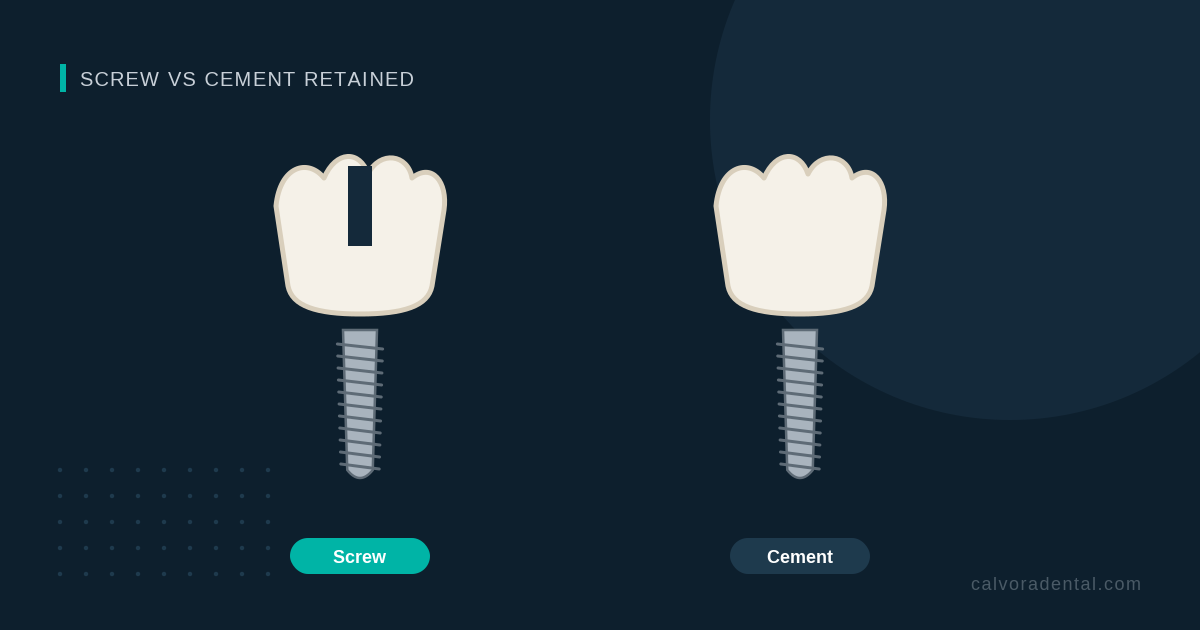
Quick answer
Screw-retained crowns are retrievable and leave no excess cement, so they are the default for most posterior and full-arch implant work today. Cement-retained crowns give an unbroken occlusal surface and tolerate implant angulation, but excess cement under the gum is a known risk factor for peri-implant disease.
The two designs
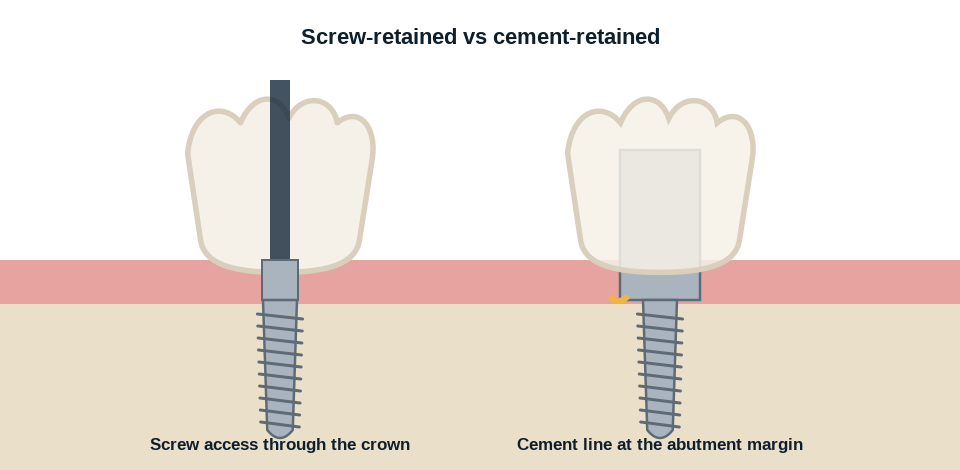
Screw-retained: the crown is joined to a titanium base (Ti-base) or abutment and screwed directly into the implant. The screw access hole is sealed with PTFE tape and composite.
Cement-retained: an abutment is screwed into the implant first, and the crown is cemented over it like a crown on a tooth.
Comparison
| Screw-retained | Cement-retained | |
|---|---|---|
| Retrievability | Easy: unscrew and remove | Difficult once cemented |
| Excess cement risk | None | Cement can be left under the gum |
| Occlusal surface | Has a screw access hole | Intact |
| Implant angulation | Needs access through the occlusal or cingulum (angled screw channels help) | Tolerates more angulation |
| Minimum height | Works with low interocclusal space | Needs enough abutment height for retention |
| Passive fit (multi-unit) | Needs an accurate framework | Cement space hides small errors |
| Screw loosening | Possible, but easy to retighten | Harder to access if it happens |
Why excess cement matters
In a 2009 endoscopic study, Wilson found excess cement in about 81% of the implants that showed signs of peri-implant disease, and symptoms resolved in most cases after the cement was removed. Deep subgingival margins make cement removal hard. If you choose cement retention:
- Use a custom abutment with the margin at or just below the gum, not deep.
- Use a small amount of cement and a vent or pre-cementation replica (a "practice abutment").
- Take a radiograph after cementing to check for radiopaque remnants.
When to choose which
| Situation | Choice |
|---|---|
| Posterior single crown, access hole on the occlusal surface | Screw-retained |
| Full-arch or multi-unit bridge | Screw-retained |
| Low interocclusal space | Screw-retained |
| Anterior with access through the facial | Cement-retained, or an angled screw channel |
| Clinician wants an intact occlusal surface | Cement-retained with a shallow margin |
What to send the lab
- Implant system, platform and diameter
- Scan body scan or an implant-level impression with the analog
- Screw-retained or cement-retained, and abutment type (Ti-base, pre-milled, stock)
- Shade, plus the opposing arch and bite
At Calvora, implant crowns get a metal trial in 30 hours, and the final is ready 24 hours after the trial returns. Please confirm component compatibility for your implant system before sending. See parts of a dental implant system.
Frequently asked questions
- Is screw-retained better than cement-retained?
- For most posterior and full-arch cases, yes: it is retrievable and avoids residual cement. Cement-retained still suits some anterior and angled implants.
- What is a Ti-base crown?
- A zirconia or ceramic crown bonded to a titanium base in the lab, then screwed into the implant as one piece.
- Can excess cement cause peri-implantitis?
- Yes. Excess cement is a well-documented risk factor for peri-implant inflammation, especially with deep subgingival margins.
References
- Wilson TG Jr. The positive relationship between excess cement and peri-implant disease: a prospective clinical endoscopic study. J Periodontol. 2009;80(9):1388-1392.